
Lenovo ThinkSystem servers are moving to AMD’s 6th Generation EPYC 9006 processors, Lenovo announced, alongside new storage arrays and wider services for organisations building artificial intelligence (AI) and high-performance computing (HPC) systems. The announcement, made in Kuala Lumpur on 23 November, targets research institutions, engineering firms and enterprises whose AI work is moving from trials into round-the-clock use.
The reasoning behind the launch is that AI and scientific computing, once run on separate systems, now share the same problems: power, cooling, memory bandwidth and the speed at which data moves between machines. Lenovo is updating each of those layers and adding services meant to get large clusters working sooner.
Key figures
- Processor: 6th Gen AMD EPYC 9006 SP7
- Up to 100% of system heat removed by water on the ThinkSystem SC755
- Up to 40% higher sustained performance than similar air-cooled systems, based on Lenovo’s internal testing
- 17.49 PFLOPS: computing power of the University of Florida’s HiPerGator, built on Lenovo, NVIDIA and AMD technology
- 33 million research requests handled by HiPerGator in the past year
Two new Lenovo ThinkSystem servers
The ThinkSystem SC755 is a dual-socket server cooled by Lenovo’s Neptune liquid-cooling system, which the company has developed for more than a decade. Water carries heat away from the components, and Lenovo says this can cut reliance on evaporative air conditioning and lower water use in large HPC, agentic AI and colocation set-ups. A feature called Dynamic Partitioning lets customers split two dual-socket systems into single-socket machines and combine them again as workloads change.

Lenovo notes that heat removal and performance depend on configuration, workload, facility water temperature and data centre conditions.
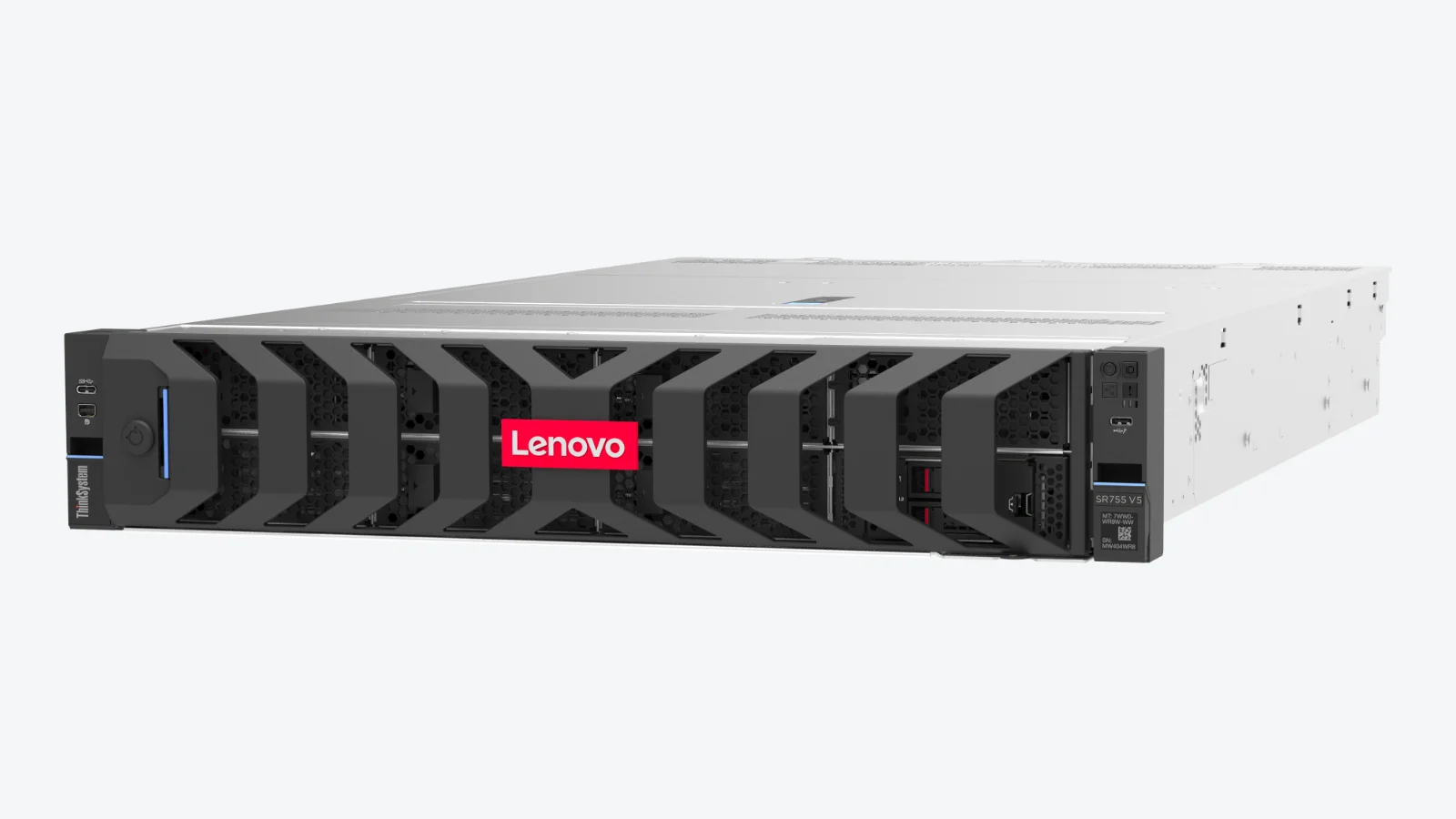
The ThinkSystem SR755 is aimed at work that needs a lot of memory bandwidth in a compact space: large-scale virtualisation, engineering simulation, financial modelling, chip design software and agentic AI. Lenovo says it uses less power and costs less to run than dual-socket configurations, a claim based on its own analysis.

Scott Patti, Vice President, Infrastructure Solutions Group, Lenovo, said customers want “more useful performance from every watt” while coping with growing power and cooling limits.
Storage and networking
Two new storage arrays sit alongside the servers. The ThinkSystem DE6800 is built for applications that move large volumes of data and need dependable storage, while the DE6500 is the lower-cost option with simpler set-up and management. Both are designed for block workloads where delays matter.
Lenovo has also validated the Cornelis CN5000 fabric, giving customers another high-speed option for linking machines in data-heavy AI and HPC clusters.
Dan McNamara, Senior Vice President and General Manager, Compute and Enterprise AI at AMD, said the platforms help customers speed up work “from engineering and scientific research to AI inferencing and agentic AI”.
Services to get AI running
Buying hardware is only part of the job, so Lenovo is widening its services for both enterprise and very large “gigafactory” AI deployments:
- Hybrid AI Factory Services: GPU deployment, configuration and tuning, with new multi-node support for Red Hat AI Enterprise, NVIDIA AI Enterprise and NVIDIA Run:ai.
- Gigafactory services: support from concept and build through to deployment, including NVIDIA Infrastructure Services expertise for cluster validation.
- Colocation with Digital Realty: access to Digital Realty’s global colocation data centres and its Innovation Lab for testing, with Lenovo as the single contact and financing through Lenovo TruScale Infrastructure as a Service.
Where the systems are already used
Lenovo pointed to existing users of its AI and HPC systems, from sovereign AI research in Bavaria, Germany, to fusion energy work at Imperial College London. DreamWorks Animation runs Neptune liquid-cooled servers in its data centre, which Lenovo says deliver up to 20% more performance and faster rendering.
The announcement did not include Malaysian pricing, availability dates or local customers. For Malaysian companies and universities planning their own AI capacity, the main points are the focus on power and cooling, and the option to rent colocation space rather than build. Other suppliers are also active here; see our report on Tec D’s appointment as an HPE distribution partner in Malaysia. On the consumer side, Lenovo recently brought its new tablet line-up to Malaysia.
Lenovo is a global technology company listed in Hong Kong, with revenue of US$83 billion. Details of the new systems are on Lenovo’s HPC solutions page.