

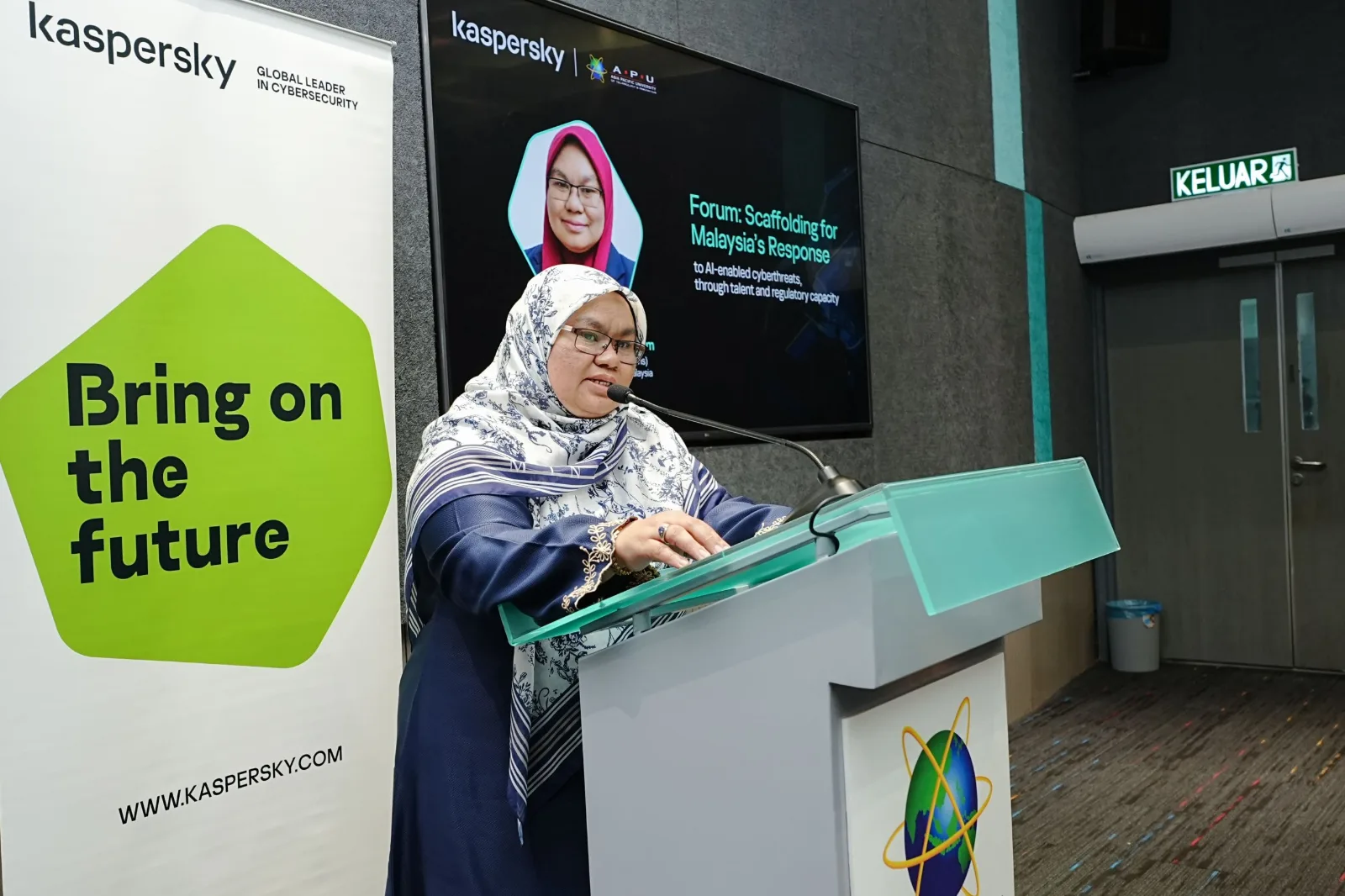
Malaysia needs more cybersecurity professionals trained for artificial intelligence, and regulation that can keep pace, to stay ahead of AI cyber threats, Kaspersky said at a forum it organised with Asia Pacific University of Technology & Innovation (APU) on 13 November 2026.
The issue is no longer hypothetical. According to Kaspersky, cybercriminals already use AI to develop malware, and emerging capabilities could one day let AI plan and coordinate an entire cyberattack with little human involvement.
Noursilawati Abdul Halim, Deputy Chief Executive (Operations) of the National Cyber Security Agency (NACSA), delivered the keynote address. The forum brought together speakers from government, universities, industry and the cybersecurity community to discuss the skills and rules the country will need to respond to AI-enabled attacks, in line with NACSA’s work on national cyber resilience.
It comes a month after Kaspersky’s phishing simulation data showed that tech and AI-themed lures drew a 45% click rate, as reported in our article on AI-themed phishing emails. This time, the spotlight moved from individual users to the people and policies behind Malaysia’s defences.
Forum at a glance
- Title: “Scaffolding for Malaysia’s Response to AI-Enabled Cyberthreats, through Talent and Regulatory Capacity”
- Date: 13 November 2026
- Organisers: Kaspersky, with Asia Pacific University of Technology & Innovation (APU)
- Keynote: Noursilawati Abdul Halim, Deputy Chief Executive (Operations), NACSA
- Topics: AI-assisted malware, AI-directed cyber operations, AI regulation overseas and cybersecurity talent
- AI rules compared: Singapore, Australia, India, the United States and the European Union
How AI is changing malware
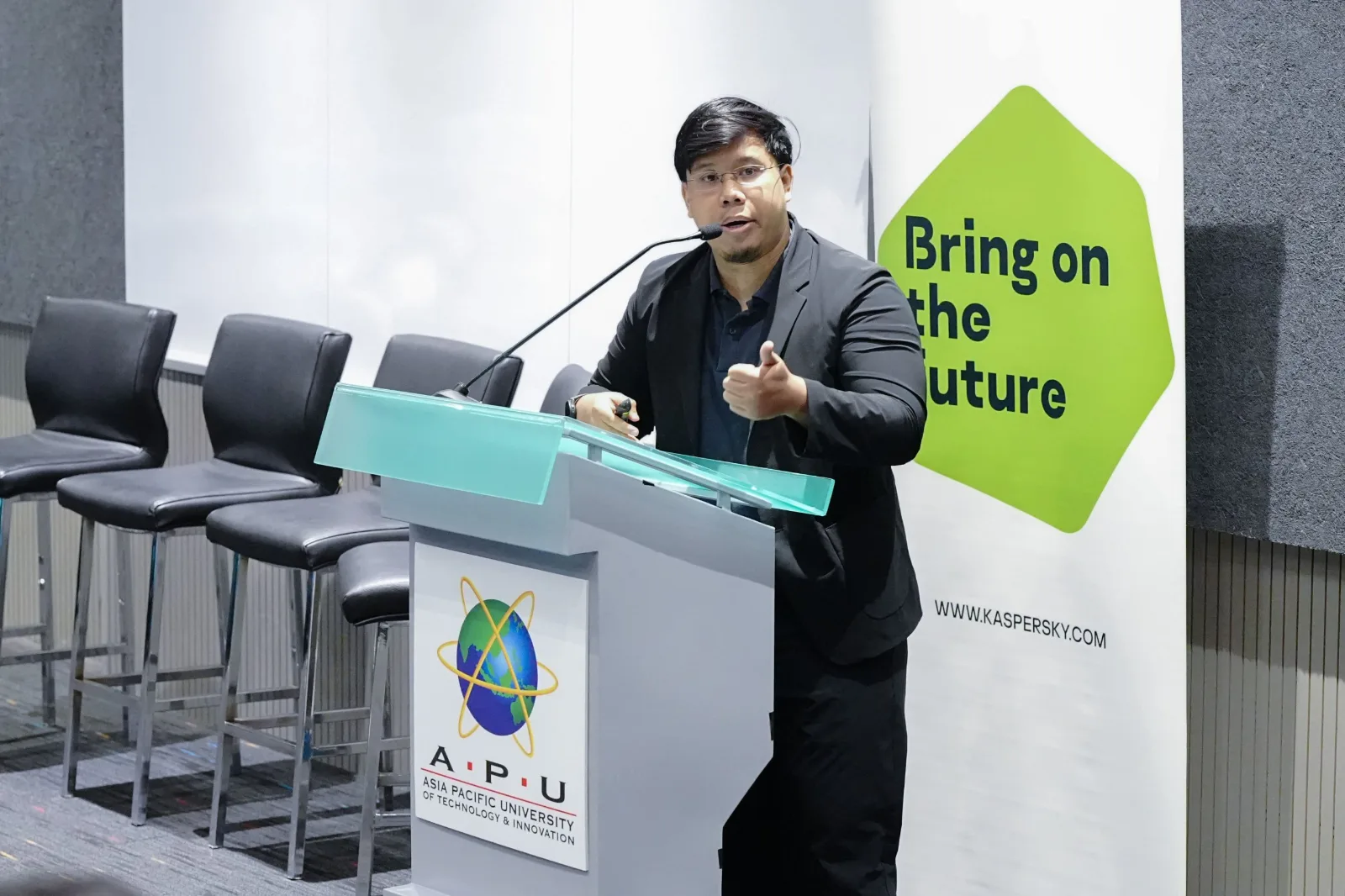
Ahmad Fareed Fauzi Mohamad Radzi, a security researcher with Kaspersky’s Global Research and Analysis Team (GReAT), said AI is making malicious software quicker and easier to build. Writing malware used to demand a good deal of technical skill. AI tools are lowering that bar.
He also pointed to early examples of malware that use AI to generate extra malicious code while they are running. In those cases, AI is no longer just the tool used to write an attack. It becomes part of the attack itself.
Defenders are turning to the same technology. Security vendors such as Cisco are now using frontier AI models to stress-test AI agents, a practice known as AI red teaming.
What other countries are doing on AI rules
Heng Lee, Kaspersky’s Director of Government Affairs and Public Policy for Asia-Pacific, compared how Singapore, Australia, India, the United States and the European Union approach AI governance. Each is trying to manage AI risks without holding back innovation, and Lee looked at what those approaches could offer Malaysia as it shapes its own rules.
The timing matters. Digital Minister Gobind Singh Deo said in late October that Malaysia’s proposed AI Governance Bill has been completed and will be submitted to the Cabinet, with plans to table it in the Dewan Rakyat by early 2027. It would be the country’s first cross-sector law on AI, following a public consultation by the National AI Office in July 2026.
On the cybersecurity side, the Cyber Security Act 2024 (Act 854) has been in force since 26 August 2024. It gives NACSA legal powers as the national lead agency for cybersecurity.
Lee said that while conversations about AI change daily, a country can rely on two pillars to stay ahead of cyberthreats: “a talent pool which has the right skills in an AI-enabled age, and a strong regulatory and institutional framework.”
Training Malaysia’s next cyber defenders
A panel then looked at how cybersecurity education, industry expertise and regulation can work together. It featured Professor Vinesh Thiruchelvam, Chief Innovation, Enterprise & Sustainability Officer at APU; Fazlan Abdullah, General Manager of the Pre-Emptive Technology and Services Division at CyberSecurity Malaysia; Tan Chee Lam, Chief Technology Officer at Revolab Sdn Bhd; and Heng Lee. Trishia Octaviano, Kaspersky’s Senior Manager for Cybersecurity Education for Asia-Pacific, moderated.
Vinesh said graduates will start work in a very different threat environment from today’s. “Universities have an opportunity to rethink the way cybersecurity is taught,” he said.
For students heading into the field, he said technical knowledge alone will not be enough. They will also need hands-on practice in:
- investigating real threats
- spotting when AI is being misused
- making sound decisions in situations they have not seen before
APU’s approach, he added, is to connect classroom learning with industry expertise so graduates build confidence, adaptability and judgement.
Kaspersky’s work with Malaysian universities
The forum is part of Kaspersky’s wider effort to build cybersecurity skills in Malaysia. With APU, the company has run initiatives such as CyberFest and the International Battle of Hackers (IBOH). It also works with Universiti Tun Hussein Onn Malaysia (UTHM) on cybersecurity education and industry knowledge exchange.
Kaspersky is a global cybersecurity and digital privacy company founded in 1997. More information is available at kaspersky.com.