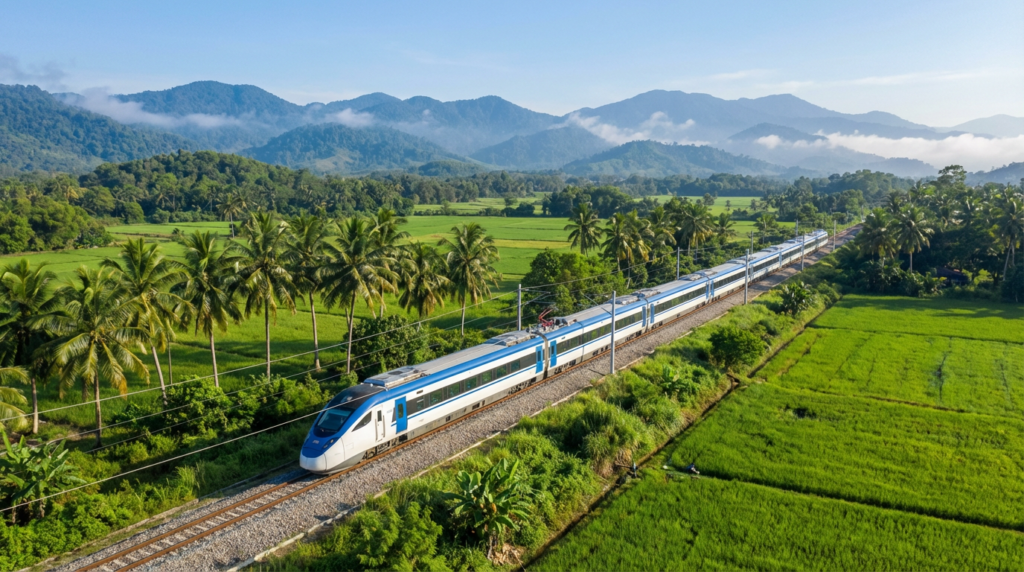
Malaysia’s East Coast Rail Link (ECRL) could begin commercial operations by mid-December 2026, bringing the long-awaited rail connection closer to carrying passengers and freight.
Malaysia Rail Link Sdn Bhd (MRL) said the earlier target follows encouraging results from system testing. The original operational timeline was January 2027, but the Ministry of Transport has requested services begin during the year-end school holidays.
The change is more than a timetable adjustment. For communities and businesses along the east coast, the railway could reshape how people, goods and economic activity move across Peninsular Malaysia.
Phase 1 Reaches 98.16% Completion
MRL said Phase 1, covering Kota Bharu to Gombak, had reached 98.16% completion as of September 2026.
The project’s engineering, procurement, construction and commissioning contractor, China Communications Construction Company Ltd (CCCC), is expected to complete and formally hand over the Phase 1 mainline, stations, buildings and work sites to MRL by mid-October.
System Integration Testing is already covering key parts of the railway, including signalling, communications, traction power and the overhead catenary system.
This progress is expected to allow the Fault-Free Run (FFR) for passenger Electric Multiple Units (EMUs) and freight electric locomotives to begin in October, a month earlier than previously planned.
Safety Testing Remains Part of the Schedule
An earlier opening date puts attention on operational readiness.
MRL said the compressed schedule will not change the safety and technical standards applied during testing and commissioning.
The Land Public Transport Agency (APAD) has agreed that the first passenger EMU will undergo a 3,000km Fault-Free Run. Subsequent EMU sets will complete 1,500km.
For freight operations, the first electric locomotive will also undergo a 3,000km FFR, including testing under different load conditions. Later units will complete 1,250km runs under scenarios set by APAD.
MRL chief executive officer Dato’ Sri Darwis Abdul Razak said the project team is working with greater intensity while maintaining the standards needed for safe and reliable operations.
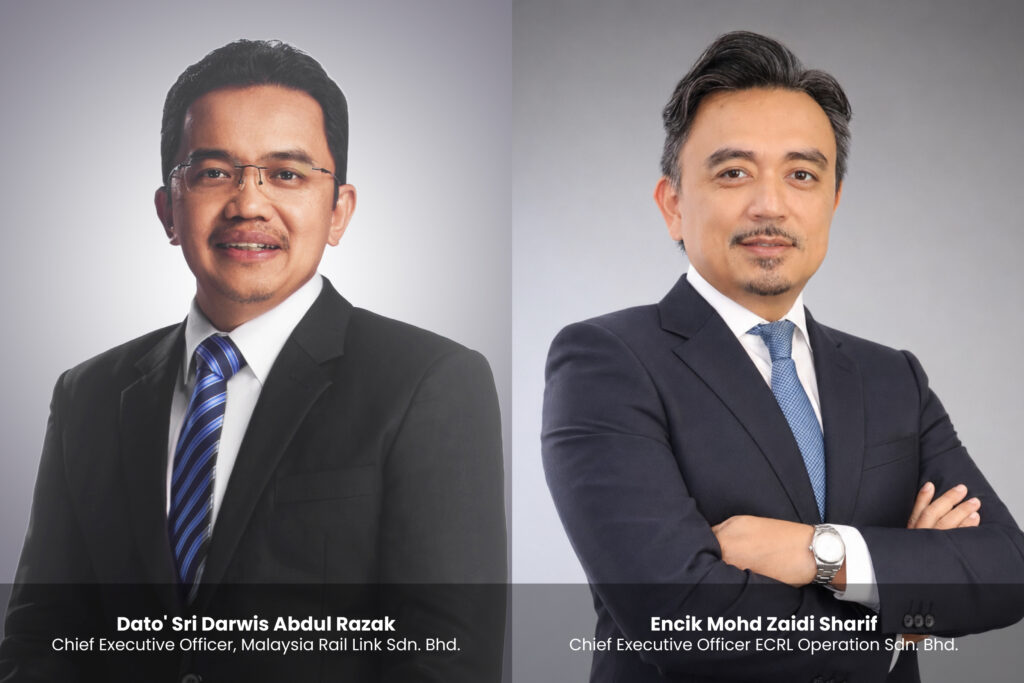
Photo (from left): Dato’ Sri Darwis Abdul Razak, Chief Executive Officer, Malaysia Rail Link Sdn. Bhd.; and Encik Mohd Zaidi Sharif, Chief Executive Officer, ECRL Operation Sdn. Bhd.
Gombak-Kota Bharu Test Completed in 3 Hours 19 Minutes
One recent test offers a clearer picture of what future journeys could look like.
The ECRL Comprehensive Inspection Train completed a 519km non-stop journey from Gombak to Kota Bharu in three hours and 19 minutes, reaching speeds of 160km/h.
According to MRL, the result supports plans for an express service covering Gombak, KotaSAS, Kuala Terengganu and Kota Bharu within four hours.
That would be a substantial change for east-west travel. MRL estimates that the operational railway could reduce travel between Kota Bharu and Gombak to about four hours, compared with roughly seven hours by road.
A New Link for Passengers, Industry and Ports
The wider impact of ECRL commercial operations will extend beyond passenger journeys.
The electrified network stretches 665km through Kelantan, Terengganu, Pahang and Selangor. Along the route are state capitals, towns, industrial areas, ports and tourism zones.
For businesses, the freight component could offer another way to move cargo between the east and west coasts. Better connections to industrial hubs and ports may also support regional supply chains and make locations along the corridor more accessible for investment.
For the public, shorter journeys could improve access between major urban centres while giving travellers another option besides long-distance road transport.
This combination gives the ECRL a broader role in Malaysia’s infrastructure development. It is both a passenger railway and a logistics corridor designed to connect areas that have historically faced longer east-west travel times.
Ticketing Systems Move Into Testing
Passenger preparations are also progressing.
MRL said integration testing is underway for the ECRL ticketing system and payment gateway. Passenger fares are expected to be officially announced towards the end of 2026.
The railway will eventually be operated and maintained by ECRL Operation Sdn Bhd, a 50:50 Malaysia-China joint venture in which MRL holds a 50% stake.
What the ECRL Could Mean for Regional Development
If the mid-December target is achieved, the ECRL will introduce a major new transport connection between Malaysia’s east and west coasts.
Its value will depend not only on faster trains, but also on how effectively stations connect with towns, businesses, tourism areas and existing transport networks.
For Kelantan, Terengganu and Pahang in particular, stronger connectivity with Selangor could open new opportunities for mobility, logistics and local economic activity.
The next few months will therefore be crucial. Testing, regulatory requirements and operational readiness still need to be completed before passenger and freight services begin.
The project is nearing that point, but its long-term impact will ultimately be measured by how safely and effectively Malaysians and businesses can use the new connection.