Humanoid robots have largely been associated with factories, warehouses and research centres. In Shah Alam, however, a Malaysian development is exploring what happens when robots move into a much more complicated environment: the home.
AgiBot and i-City are developing domestic robotics applications for AI Living @ i-City, a planned 500-home residential project scheduled for completion in 2030. The collaboration aims to explore how humanoid robots in homes could support residents as their needs change over time.
The project also reflects a wider shift in Asia’s AI story. Artificial intelligence is moving beyond screens and software into physical environments, raising new possibilities for housing, urban development and everyday services.
From Industrial Robots to Everyday Living
Founded in Shanghai in 2023, AgiBot develops embodied AI and robotic systems. Its machines are already used across manufacturing, logistics, hospitality, entertainment, security, education and research.
The company produced more than 5,000 humanoid robots by the end of 2025, according to information provided in the press release. It also announced in June 2026 that its 15,000th robot had rolled off its production line. These figures should be independently fact-checked before publication.
Moving into homes creates a different test.
A factory usually has predictable layouts and clearly defined processes. Homes are filled with furniture, personal belongings, changing routines and people of different ages and physical abilities.
A useful domestic robot therefore needs more than the ability to repeat a task. It must navigate safely, interact naturally with residents and adapt to situations that may change from one day to another.
AI Living @ i-City Becomes a Real-World Test Environment
This is where AI Living @ i-City comes into the picture.
Rather than designing homes around one generation of technology, the project is intended to provide an adaptable environment where new AI systems, robots, intelligent appliances and wellness technologies can be introduced over time.
For AgiBot, that creates an opportunity to study domestic robotics outside a controlled laboratory.
“The home represents an important next application frontier for embodied intelligence,” AgiBot founder, chairman and chief executive officer Deng Taihua said.
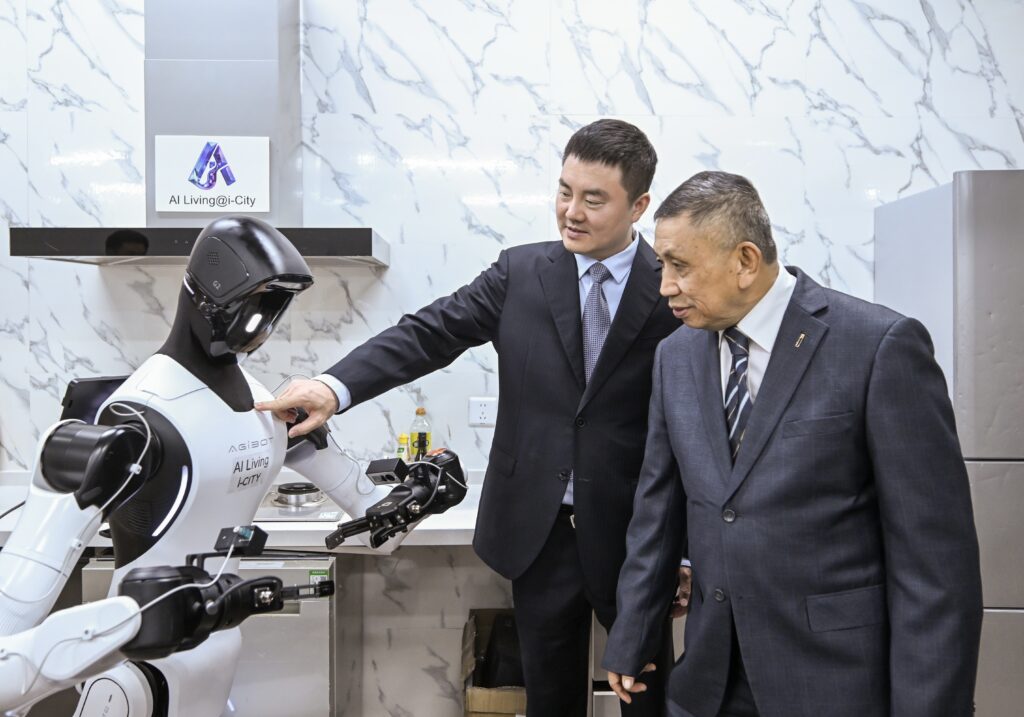
AgiBot founder, chairman and chief executive officer Deng Taihua (left) recently hosted i-City founder and chairman Tan Sri Lim Kim Hong (right) at AgiBot’s AI Living Lab in Shanghai, where the two leaders reviewed progress on their AI Living @ i-City collaboration, including AgiBot’s latest domestic robotics developments and how their evolving capabilities could be applied within the residential environment.
He said the AI Living Lab is examining what domestic robots need to do, how they should interact with people and how their abilities could change alongside residents’ needs.
The approach matters because the usefulness of residential technology is unlikely to remain the same throughout a person’s life.
A younger resident may value help with routine household activities. Later, similar systems could potentially support mobility, wellness or daily assistance.
Housing That Changes With Its Residents
For i-City developer I-Berhad, the collaboration is also about how future homes are designed.
Instead of treating AI as another fixed feature installed when a property is completed, AI Living is being planned around technology that can continue to evolve.
I-Berhad chairman Tan Sri Lim Kim Hong said the aim is to design the residential environment around changing human needs rather than around the capabilities of today’s robots.
That distinction could become increasingly relevant to property developers. Buildings normally last far longer than individual generations of consumer technology. Homes designed with adaptable digital infrastructure may be better placed to accommodate technologies that have not yet reached the market.
The press release describes AI Living @ i-City as the “world’s first AI residence”. As this is a company claim, independent verification would be advisable before retaining that description in publication.
Robotics-as-a-Service Could Lower the Ownership Barrier
One notable part of the plan is i-City’s proposed Robotics-as-a-Service model.
Under the concept, residents could access newer generations of domestic robots without having to buy and maintain the machines themselves. As the technology improves, different capabilities could potentially be introduced over time.
This could be significant for consumer adoption.
Advanced robots are likely to change quickly as hardware, AI models and applications improve. A service model could reduce the risk of residents being tied to expensive technology that becomes outdated.
It may also create a new business layer around residential robotics, including maintenance, software services, technical support and specialised applications.
Why Domestic Robotics Matters for Malaysia
The public benefit will ultimately depend on whether these technologies solve practical problems.
Convenience is one possibility, but the longer-term value could extend to ageing populations, mobility support and independent living. Those applications will require careful attention to safety, privacy, reliability and affordability.
For Malaysia, the i-City project also provides a chance to participate in an emerging technology sector through real-world deployment rather than simply consuming finished products developed elsewhere.
The partnership has already moved beyond demonstrations. More than 100 AgiBot robots have been deployed at i-City’s AI World Experience Centre, according to the release. AI Living would take the relationship into residential use.
A photo supplied with the announcement shows Deng Taihua hosting Tan Sri Lim Kim Hong at AgiBot’s AI Living Lab in Shanghai, where they reviewed domestic robotics developments for the i-City collaboration.
A Small Test for a Much Bigger Market
Domestic robotics remains an emerging field, and many questions around cost, safety and everyday usefulness still need answers.
That makes the 500-home development interesting beyond its size. It could offer practical lessons about how people respond to humanoid robots in homes, which tasks residents actually value and how residential infrastructure needs to change as AI becomes more physical.
If those lessons prove useful, Malaysia could have an early role in shaping how intelligent homes develop across Asia.
The bigger opportunity is not simply having a robot at home. It is creating homes that can keep adapting as technology — and the people living with it — change.